
Mayan Codex Craft: Make a Maya Folding Book
Discover ancient Maya writing, symbols, and calendars while creating your own colorful folding codex book.


Explore the fascinating technology behind frigates and their role in modern naval defense. This guide breaks down the science of sonar, explaining how hull-mounted sensors and variable depth sonar (VDS) allow ships to detect silent underwater threats. Whether you are working on a science project or are curious about naval history, understand the strategic advantages—like sonobuoys and anti-sub helicopters—that make frigates the ultimate submarine hunters.
Who Were the Maya and Why Did They Write Codices?
The Maya lived across what is today southern Mexico, Guatemala, Belize, Honduras, and El Salvador. Their civilisation flourished for more than 2,000 years, and at its height (around 250–900 CE) the Maya built towering stone pyramids, tracked the movements of the planets with astonishing accuracy, and developed an incredibly detailed calendar system.
To record everything they observed and believed, the Maya created folding books known as codices. A Maya codex was made from long strips of bark paper (called amate) or deer skin, coated in a thin layer of white plaster, and folded into a zigzag shape so it could be opened up like an accordion. Skilled scribes called ah ts’ib painted the pages with colourful symbols using brushes made from animal hair.
Inside these books, scribes recorded:
- Astronomical observations — including the cycles of Venus, eclipses of the Sun and Moon, and the movement of the stars.
- Calendars and almanacs — to predict good days for planting, harvesting, war, and religious ceremonies.
- Lists of gods and rituals — describing how priests should perform offerings.
- Histories and prophecies — recording important events and what was thought to come next.
Fascinating Fact: Only Four Survive
The Maya once produced thousands of codices, but in the 16th century Spanish missionaries burned almost all of them, believing they contained "lies of the devil." Today, only four authentic Maya codices survive: the Dresden Codex, the Madrid Codex, the Paris Codex, and the Maya Codex of Mexico (sometimes called the Grolier Codex). They are named after the cities where they are now kept.
Understanding Maya Writing: Glyphs and Symbols
Maya writing is one of the most beautiful and complex writing systems ever invented. Instead of using letters like the English alphabet, the Maya used glyphs — small picture-symbols that could stand for either a whole word or a sound. Hundreds of these glyphs were carved on temple walls, painted on pottery, etched into jade, and of course written in codices.
There were two main types of Maya glyphs:
- Logograms — picture-symbols that represented an entire word, such as "jaguar" or "king."
- Phonetic signs — symbols that represented a syllable (a consonant + vowel sound). Just like the letters of an alphabet, these could be combined to spell out words and sentences.
If you went to a Maya school, you would have spent years learning to recognise thousands of different picture-symbols. You would also be taught to link them together in your mind, like a series of clues, to find out what they meant. Maya scribes were among the most respected members of society — many of them were nobles or even royalty.
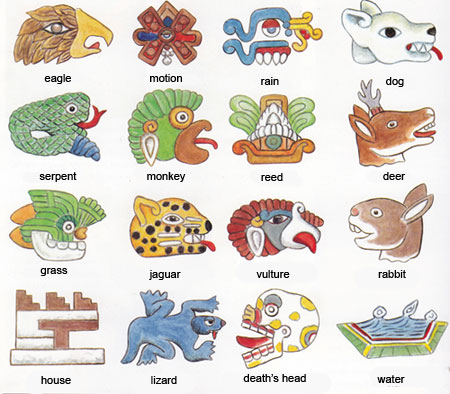
Names of the Days
The symbols above represent some of the names of the 20 days from the Maya farmers' calendar (called the Haab'). The 20 days made up one month, and there were 18 months of 20 days plus a special 5-day period at the end, giving a 365-day year. Each day was paired with a number from 1 to 13 to give a date such as "Three Vulture" or "Seven Deer."
Days were often named after familiar creatures or natural things — like the lizard, jaguar, vulture, water, wind, or maize. Each day also had its own god who watched over it. Maya children were frequently named after the day on which they were born, so two siblings might have completely different "day names" depending on the moment they entered the world.
The Maya Number System
The Maya were brilliant mathematicians. Their number system used only three signs:
- A dot (•) stood for the number one.
- A bar (—) stood for the number five.
- A shell shape stood for zero.
By stacking these symbols, you could write any number. For example, two dots above a bar means 5 + 2 = 7, and three bars stacked together means 15. Remarkably, the Maya were one of the very first civilisations in the world to use the concept of zero — long before it appeared in European mathematics.
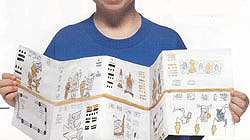
How to Make Your Own Mayan Codex: Step-by-Step
Now it's your turn to be a Maya scribe! This craft is perfect for school history projects, social studies presentations, or just a rainy-afternoon activity. It takes about 45 minutes (plus drying time) and is suitable for ages 8 and up with light adult help for cutting.
What You Will Need
- Thin card (poster board works well)
- Ruler and pencil
- Scissors
- White acrylic paint and a large paintbrush
- Water pot
- Eraser
- Tracing paper
- A selection of acrylic paints in bright colours (red, yellow, blue, green, brown, black)
- A palette (or an old plate)
- A selection of small paintbrushes for fine detail
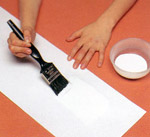 Step 1
Cut and Prime the Card
Draw a rectangle measuring 39½ inches long by 10 inches tall (about 100 cm × 25 cm) onto your piece of thin card and carefully cut it out. Cover the whole rectangle with an even coat of white acrylic paint to mimic the plaster coating used on real Maya bark paper. Leave it to dry completely — about 20–30 minutes.
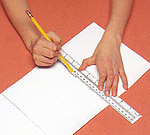 Step 2
Mark the Fold Lines
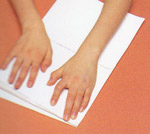
Using a pencil and ruler, lightly draw four fold lines, each spaced 8 inches apart, across the painted card. This will divide the card into five equal sections — each one will become a "page" of your codex.
 Step 3
Fold into a Zigzag Book
Carefully fold the card along your pencil lines, alternating the direction of each fold to create a zigzag (concertina) book, just like a real Maya codex. Once the folds are crisp, gently unfold the card so it lies flat again, and rub out the pencil lines with an eraser.
 Step 4
Draw Your Maya Glyphs
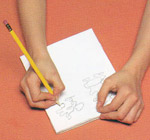
Use tracing paper to copy some of the Maya codex drawings shown on this page, or invent your own Mesoamerican-style symbols. Try drawing a jaguar, the Sun god, a vulture day-glyph, or scribes at work. Sketch them lightly in pencil first so you can adjust before painting.
 Step 5
Paint and Add Maya Numbers
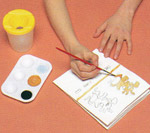
Bring your codex to life with bright acrylic paints. The Maya loved red, yellow, turquoise blue, and black. Don't forget to add a few Maya numbers using dots, bars, and shell shapes — perhaps to "date" your pages just like a real scribe would have done.
Tip From a Maya Scribe
Real Maya scribes always read their codices in a specific order — usually starting at the top-left and following a zigzag pattern down the page. Try giving your codex a "story" by drawing each page in a sequence, so a friend can "read" your book the way a Maya priest once would.
Frequently Asked Questions About the Mayan Codex
What is a Mayan codex?
A Mayan codex is an ancient folding book made by the Maya people of Mesoamerica. It was written on long strips of bark paper or deer skin coated in white plaster, then folded like a concertina. Inside, scribes painted glyphs and pictures recording astronomy, calendars, prophecies, and religious rituals.
How many original Maya codices still exist today?
Only four. The Dresden Codex, the Madrid Codex, the Paris Codex, and the Maya Codex of Mexico are the only authentic surviving examples. The rest were destroyed by Spanish missionaries during the colonisation of the Americas in the 1500s.
What did the Maya write about in their codices?
Maya codices contained astronomical tables (especially of Venus and the Moon), almanacs for farmers, ritual calendars, lists of gods, prophecies, and ceremonial instructions. Priests used them to plan ceremonies and to predict the future.
How does the Maya number system work?
The Maya number system used three symbols: a dot for 1, a bar for 5, and a shell shape for 0. By combining these symbols, the Maya could write any whole number. They were one of the earliest civilisations in the world to use the number zero.
How long is the Maya calendar?
The Maya used several calendars at once. The Haab' was a 365-day solar calendar with 18 months of 20 days plus 5 extra days. The Tzolk'in was a 260-day sacred calendar. Together they formed the Calendar Round, a cycle of about 52 years.
Is making a codex a good school history project?
Yes! A Mayan codex craft is a hands-on way to learn about ancient writing, calendars, and Mesoamerican art. It works wonderfully for history, social studies, art, and even maths lessons (thanks to Maya numbers).
 Durga Puja
 CLAT Aspirants
 Craft Ideas for Kids
 Benefits of Yoga for Kids
 School Projects & Homework Help
 Hobbies: Philately, Fishing, Camping
 Fun and Jokes